
The Minimum Drinking Age Now Versus Then
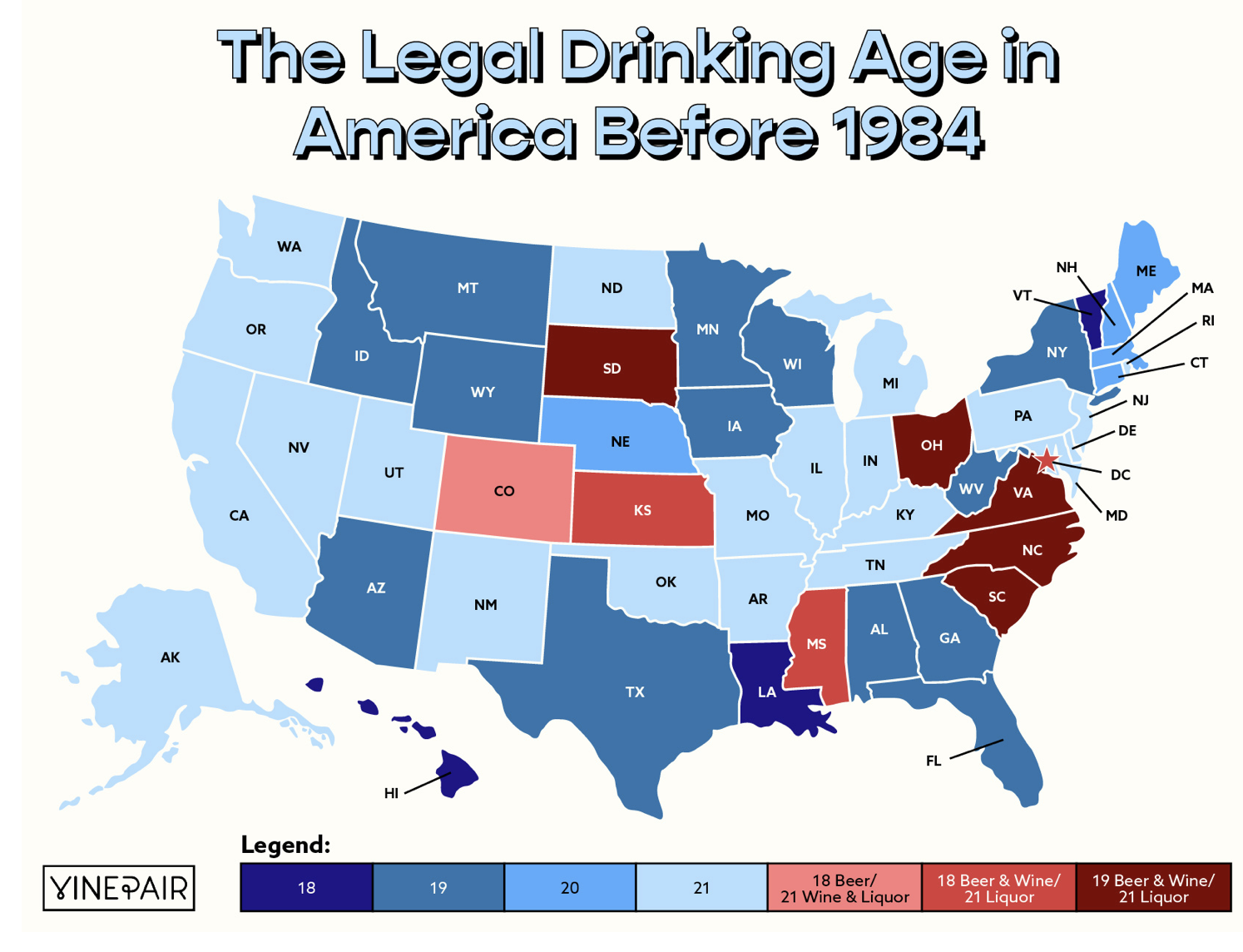
I came across a recent article from Vine Pair, and it led me to think about the minimum drinking age and how different it was in my day. I think you’ll find this interesting.
When Did the Federal Law Change?
President Ronald Reagan signed the National Minimum Drinking Age Act into law on July 17, 1984.
Technically, the federal government could not directly set a national drinking age due to state sovereignty under the 21st Amendment. Instead, the law mandated that any state failing to raise its minimum purchase and public possession age to 21 by October 1986 would forfeit 10% of its federal highway funding. The financial pressure worked: states quickly complied, with Wyoming becoming the last state to officially raise its drinking age in July 1988.
Lowest and Oldest Drinking Ages Before 1984
When the 26th Amendment lowered the U.S. voting age from 21 to 18 in 1971, 29 states followed suit by lowering their drinking ages to 18, 19, or 20.
Lowest Drinking Age: 18 years old was the lowest legal limit set by any state. States like New York, Hawaii, Louisiana, Vermont, and Wisconsin permitted 18-year-olds to purchase all alcohol types. In some states like Ohio or Illinois in earlier decades, 18-year-olds could buy 3.2% beer, but 18 was the absolute baseline for full legal adulthood.
Oldest Drinking Age: 21 years old was the highest minimum drinking age in the country. Even during the 1970s wave of lowering the limits, 21 states—including California, Pennsylvania, Kentucky, Washington, and Oklahoma—maintained a strict drinking age of 21.
What Prompted the Federal Change?
The nationwide shift back to age 21 was driven by three main factors:
Surging Youth Traffic Fatalities: Following the reduction of drinking ages in the 1970s, national statistics revealed a devastating spike in drunk driving accidents and fatal crashes among 18-to-20-year-olds.
“Blood Borders”: Because neighboring states had different legal limits, teenagers frequently drove across state borders to drink legally and then drove home drunk. These interstate transit corridors earned the tragic moniker “blood borders” due to high crash.
For me, this included Canada, where we could easily drive across the international border from Detroit and drink at 19, which we often did. We also used to stop at their government run beer stores and smuggle a case or two back home.
Grassroots Advocacy (MADD): Founded in 1980 by Candy Lightner after her 13-year-old daughter was killed by a repeat drunk driver, Mothers Against Drunk Driving (MADD) galvanized public opinion. MADD lobbied Congress aggressively, presenting public health data that showed setting the drinking age at 21 significantly reduced highway deaths.
The policy proved effective: the National Highway Traffic Safety Administration (NHTSA) estimates that raising the minimum drinking age to 21 has saved over 31,000 lives on American roads since its implementation.
It’s interesting to see how the times have changed. I think we’d all agree, for the better, when it comes to the minimum drinking age. Of course, this doesn’t stop complete access, as I can attest as I pick up beer cans on the street from high schoolers cruising around on Friday and Saturday nights. But it does provide some safety rails and definitely saves lives.
Leave a Reply
Become an insider and receive weekly advice, tips, and insight on all things whiskey
.
Weekly tips, reviews and recommendations to help you enjoy whiskey life to the fullest.
JOIN THE LIST

Sippin' With Jordan Davis
sippin' with the stars

Million Dollar Cowboy Bar WY
old fashioned aF

5 Steps To Sip and Savor Whiskey
whiskey 101

COMMENTS